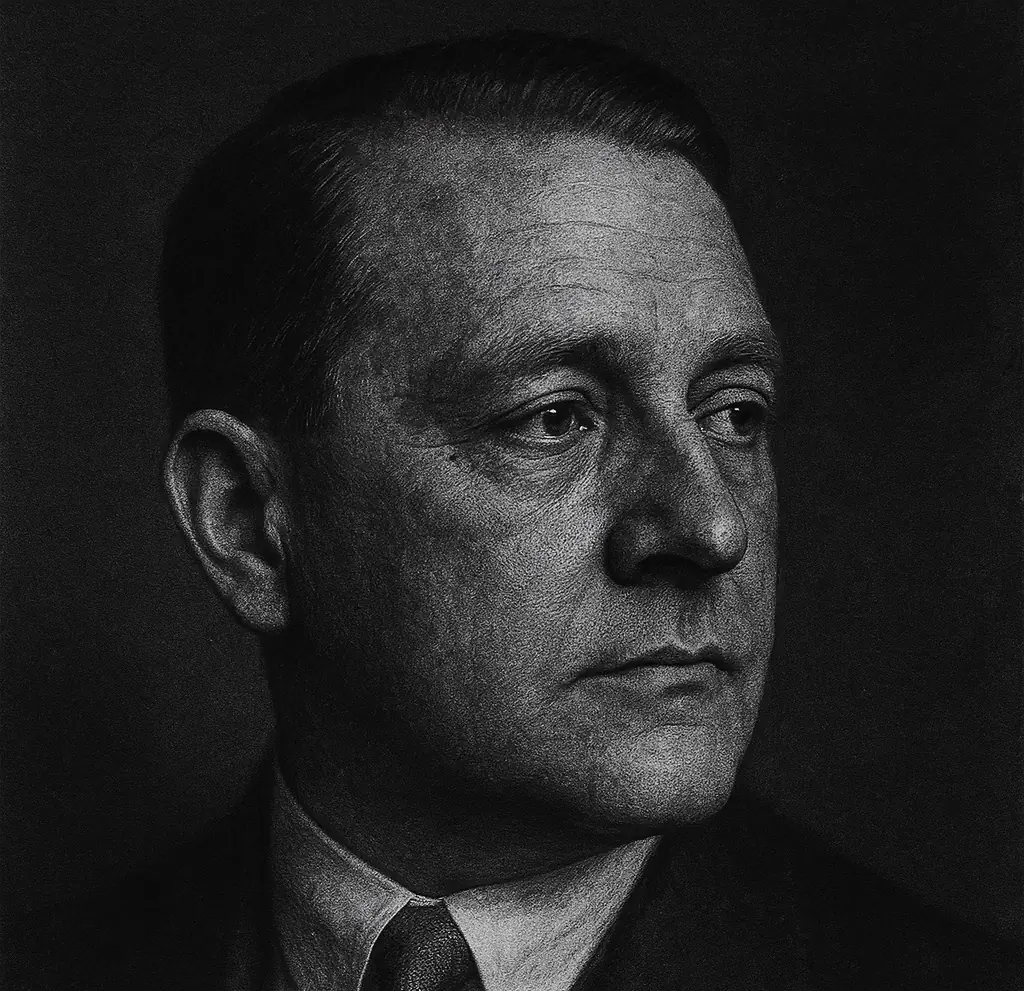
Liberal politics tells you that politics is argument. Parties disagree, voters choose, institutions mediate, and public reason slowly improves the world. Carl Schmitt looked at that story and saw a mask.
For Schmitt, the political begins with the friend-enemy distinction. Not private dislike. Not online rudeness. Not ordinary competition. The political appears when a group decides that another group represents a real threat to its way of life, its order, or its existence.
Every serious regime makes this distinction. The only question is whether it admits it.
Subject 01: The Primary Distinction
Friend and enemy
Schmitt did not mean that politics is built on personal hatred. The enemy is not someone you find annoying. The enemy is a public category: a group treated as a threat to the collective form of life.
That is why the friend-enemy distinction is colder than ordinary partisanship. It asks who belongs inside the protected order and who may be treated as an outsider, saboteur, invader, extremist, traitor, disease vector, or security problem.
Politics becomes serious when disagreement stops being a debate and becomes a question of survival, loyalty, and protection.
This is why Schmitt belongs next to the state of exception. The exception shows who decides. The friend-enemy distinction shows who the decision is aimed at.
Subject 02: Liberal Denial
Why liberalism cannot admit the enemy
Liberalism prefers to describe politics as procedure, markets, rights, discussion, and technical administration. It wants a world where conflict can be dissolved into rules. Schmitt thought this was fantasy.
The enemy does not disappear because liberalism refuses the word. The enemy is renamed. He becomes a criminal, extremist, bigot, misinformation source, threat to democracy, public health risk, or administrative anomaly.
- 01.
Political conflict becomes law enforcement. The opponent is no longer wrong; he is unlawful or dangerous.
- 02.
Political dissent becomes pathology. The opponent is not making a claim; he is hateful, phobic, radicalised, or unwell.
- 03.
Political decision becomes expertise. The opponent is not defeated politically; he is processed by managers.
This is not the end of enmity. It is enmity laundered through therapeutic and bureaucratic language.
Subject 03: Camouflage
Neutrality as camouflage
The modern regime rarely says, “we have enemies.” It says it is defending democracy, safety, inclusion, public order, public health, expertise, or human rights. These may sound neutral. They are not neutral when they define who may speak, organise, bank, travel, publish, assemble, or work.
Courts, NGOs, media systems, regulators, universities, and expert bodies all claim procedural distance from politics. Yet each can enforce friend-enemy boundaries. They decide whose suffering counts, whose speech is dangerous, whose association is suspicious, and whose violence is contextual.
This is the function of political formulas. They turn partisan protection into moral administration. The regime does not say it is defending friends and punishing enemies. It says it is applying values.
Neutral language is often where the hardest political decisions hide.
Subject 04: Regime Diagnostics
The enemy reveals the regime
You understand a regime by watching who it treats as a legitimate opponent and who it treats as an enemy. The distinction is visible in patterns of permission and punishment.
Protection
Who receives institutional patience, explanation, legal creativity, and sympathetic media framing?
Exposure
Who is made visible, searchable, deniable, deplatformed, bank-risked, or professionally radioactive?
Exception
Against whom are ordinary standards suspended because the threat is said to be too serious?
The official constitution may speak of rights. The operational constitution is revealed by enemy designation. Who can be lied about? Who can be surveilled? Who can be ruined for a sentence? Who can riot and still be explained?
Subject 05: Managed Consent
Democracy and depoliticisation
Modern democracy does not abolish the friend-enemy distinction. It hides it behind procedure. The public is told that institutions are merely enforcing rules, defending norms, or protecting democracy from threats.
This is why the democratic illusion is so useful. It converts rule into process. It convinces the governed that political exclusion is not exclusion at all, but the neutral operation of responsible institutions.
The more a regime claims to have moved beyond politics, the more carefully you should watch its enemy categories. No regime has no enemies. Some regimes are simply more dishonest about naming them.
Subject 06: Strategic Result
Politics never disappears
Schmitt's value is not that he makes politics pleasant. He makes it visible. Politics never disappears. It only changes costume.
A serious observer stops asking whether the regime is neutral and starts asking sharper questions: who is being named, who is being protected, who is being made untouchable, and who is being made socially, legally, or materially killable?
The friend-enemy machine is always running. The liberal trick is persuading you that only its enemies are political.
Manual Integration
Further Orientation
The enemy has been named. The next step is understanding who decides when ordinary rules are suspended.