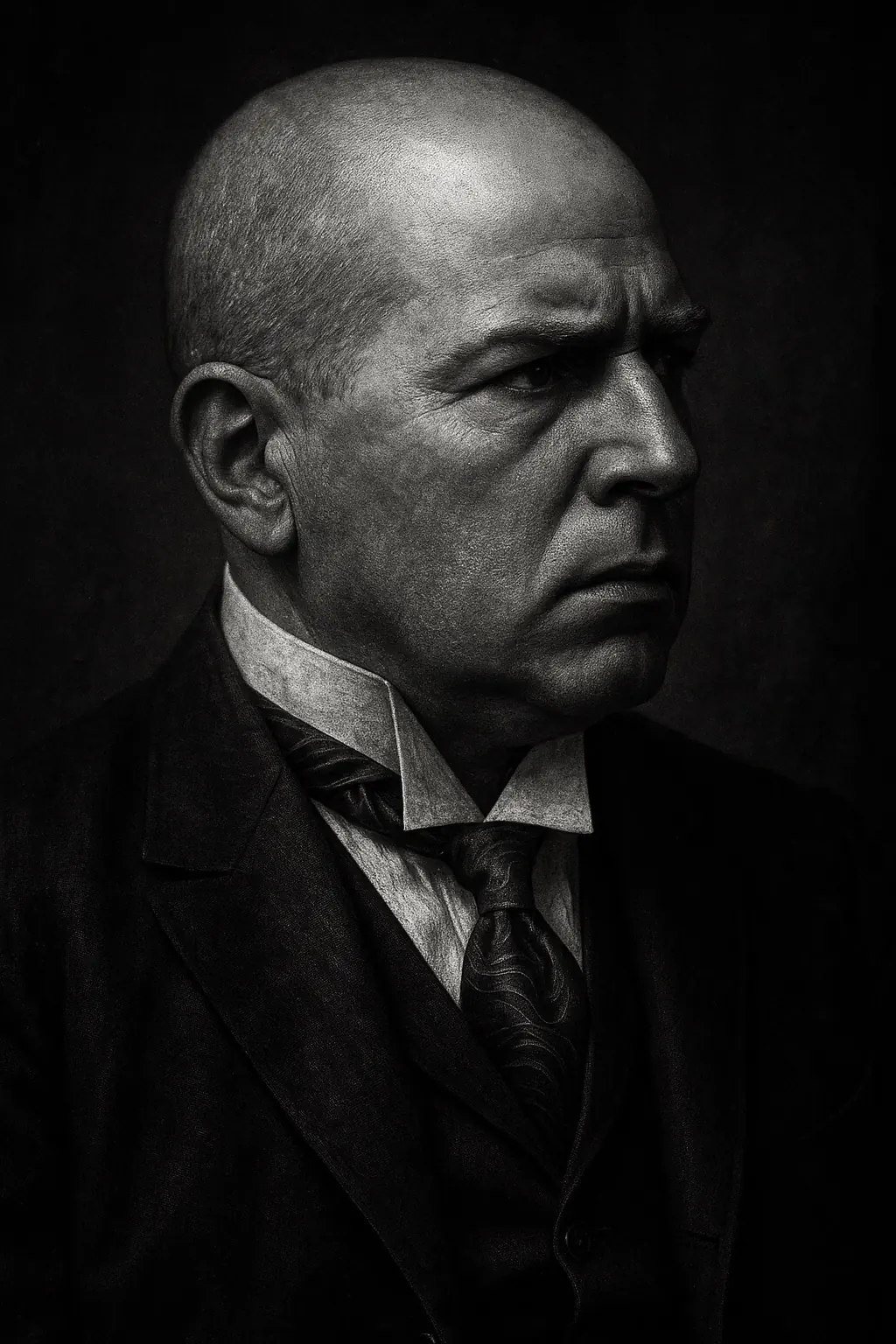
Democracy likes to describe itself as the final form of political maturity: ballots, rights, parties, courts, debate, representation. Oswald Spengler saw something colder. In the late phase of a civilisation, democracy does not mature into permanent self-government. It decays into money rule, institutional exhaustion, and finally Caesarism.
Caesarism is not merely one man shouting over a parliament. It is the stage after democratic forms have lost their inner authority. The vocabulary remains democratic. The rituals continue. The public still hears speeches about consent and values. But real power migrates toward money, administration, media, security, and crisis decision.
The result is a landscape of rival castles inside one official state.
Subject 01: Late Civilisation
Spengler's frame
Spengler was not offering a standard election-cycle theory. He treated cultures as historical organisms: they rise, flower, harden, urbanise, bureaucratise, and eventually enter civilisation, the late stage where creative life gives way to mass politics, money, technique, and administration.
In that late stage, liberal democracy becomes less a living civic order than a method of managing masses. Parties compete, platforms rank and suppress, media systems moralise, financiers fund, experts administer, and citizens are taught to confuse political theatre with command.
For Spengler, the decline of democracy is not a sudden failure of procedure. It is the ageing of a political form whose inner force has drained away.
This connects directly to rule by the few and rule of the many. Democracy continues to speak in the name of the many while organised minorities learn how to operate the machinery.
Subject 02: Money Power
Democracy becomes rule by money
Spengler's most useful political insight is that late democracy tends to become rule by money. Not because every politician is personally bribed, but because mass politics requires parties, campaigns, patronage, expertise, polling, legal systems, foundations, social media operations, platform access, paid distribution, and permanent organisation.
Money supplies continuity where public opinion is intermittent. It funds the staff, research bodies, media organs, influencer networks, ad campaigns, data operations, and pressure groups that decide which options become visible. The voter chooses inside a field already shaped by organised capital and professional management.
- 01.
Parties need money. Selection, messaging, data, travel, legal compliance, and media all require patrons.
- 02.
Opinion needs infrastructure. Newspapers still matter, but the decisive terrain is now social feeds, search results, recommendation systems, paid reach, demonetisation, throttling, and platform policy.
- 03.
Policy needs specialists. The expert class turns donor priorities and bureaucratic preferences into neutral necessity.
This is why Spengler belongs beside Burnham's managerial revolution. Money opens the gates. Managers occupy the rooms.
Subject 03: Rival Fortresses
Rival castles inside the same state
“Rival castles” is the right image for late democracy, even if it should be treated as a ZeroCopes translation rather than a neat Spengler quotation. The official state presents itself as one constitutional order. Operationally, power is distributed among fortified institutions with their own walls, budgets, clients, and doctrines.
Party Castles
Candidate machines, activist pools, donor channels, compliance teams, and campaign professionals.
Administrative Castles
Civil services, regulators, courts, police systems, public health bodies, and security agencies.
Narrative Castles
Media blocs, universities, NGOs, platforms, fact-checkers, cultural institutions, and reputational enforcers.
These castles compete, bargain, and occasionally attack one another. But they also share an interest in keeping the mass public outside the walls. That is Mosca's ruling class translated into late-civilisation architecture.
Subject 04: The Caesar
Caesarism after exhaustion
Caesarism appears when procedural legitimacy can no longer carry the political load. The public grows tired of managerial speech, coalition paralysis, visible corruption, failed institutions, and elite immunity. It wants decision.
The Caesar does not arrive because people have suddenly become irrational. He arrives because the old democratic formula has stopped resolving conflict. Where parties cannot decide, where courts cannot settle, where bureaucracy cannot inspire, and where money cannot hide its own rule, a figure of command becomes imaginable.
This does not mean liberation. Caesarism can break money power, or it can become its sword. It can discipline rival castles, or merely crown the strongest one. The point is not that Caesarism is good. The point is that late democracy prepares the desire for it.
Pareto would call this a problem of elite circulation. When foxes become too clever, too soft, too legalistic, and too detached from force, the system begins to summon lions.
Subject 05: Strategic Result
The final form is not procedure
Spengler's warning is not that one election will end democracy. It is that democracy can survive as costume after its substance has moved elsewhere. The late regime keeps the ballot, the speech, the panel, the inquiry, and the values statement. Command migrates to money, administration, security, and emergency coordination.
The strategic question is therefore not whether democracy will be ceremonially preserved. It probably will be. The question is which castle actually decides, which enemies are named, which elites circulate, and whether the eventual Caesar disciplines the system or simply inherits it.
After democracy comes Caesarism because politics cannot remain a debating society forever. When money has hollowed out procedure and procedure can no longer command belief, the demand for decision returns.
Manual Integration
Further Orientation
The democratic costume remains. The next step is understanding how the friend-enemy machine decides who belongs inside the protected order.